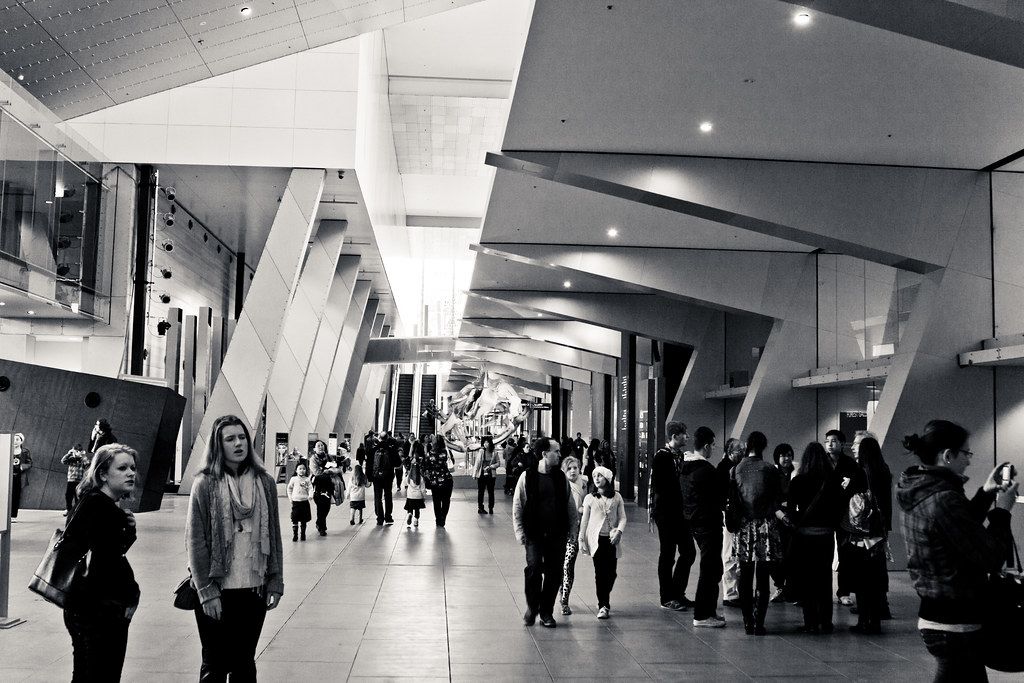



Melbourne Museum, Australia
Published 5 June 2020
The gist: Melbourne Museum is conceived as a place to move through, with parallel internal routes giving order to a varied collection of forms. Dramatic entry blades and a visible structural framework announce its scale, while the small-town analogy gives visitors a way to understand the building beyond its exterior.
Location: 11 Nicholson St, Carlton, Melbourne
Year built: 1996
Architect: Denton Corker Marshall
Designed in 1993 and completed in 1996, the Melbourne Museum appears as an ambitious, commanding structure. Its geometric construction and gridlocked lines reflect a dynamic and artistic elegance, unmissable by the eye.
The enormous entry ‘blades’ that define the structure perfectly encapsulate a sense of drama and eccentricity. Denton Corker Marshall intended for the entire structure to reflect a small town, with two parallel ‘boulevards’ allowing for clarity and legibility of movement. Visitors can pass freely through and around the building, charting their route as they travel.
The entire complex is encased by a structured metal framework, from which various sections of the museum emerge. Denton Corker Marshall envisioned an irregular composition of forms, held in by tension, as represented by the tumbling, segmented form of the structure.
About Denton Corker Marshall
Founded in Melbourne, Australia in 1972 by architects John Denton, Bill Corker and Barrie Marshall, Denton Corker Marshall is now an international practice.
In Australia, admirers have described Denton Corker Marshall’s work as minimalist, modernist, sculptural and heroic. Their design approach considers the individuality of each site, with a focus on geography and movement. The firm’s architects intensely study the behaviour and flow of people as they move through and around spaces, and employ this in their work.
Read about Modernist Architecture.
The company is known for designing several landmark buildings around Melbourne and the world, including the Melbourne Exhibition Centre, the Melbourne Gateway, Bolt Bridge and the award-winning Manchester Civil Justice Centre. Significant honours include winning the Gold Medal in the 1996 Australian Institute of Architects awards.
The inviting and exciting feeling of walking in the front doors never gets old. I love how the space is always able to tell a story.
– Carly Thomas
Photos by